

In today’s interconnected business environment, organizations rely heavily on third-party vendors to deliver critical products and services. While these partnerships create opportunities, they also introduce risks, cybersecurity vulnerabilities, compliance gaps, operational disruptions, and reputational damage, to name a few.
A risk-based approach to vendor management ensures that companies prioritize their oversight and resources where they matter most. Instead of treating all vendors equally, this method classifies vendors by the level and type of risk they pose, whether cyber, operational, reputational, financial, or regulatory. By aligning controls with risk exposure, organizations can strengthen resilience, improve efficiency, and meet compliance obligations without overburdening low-risk vendors.
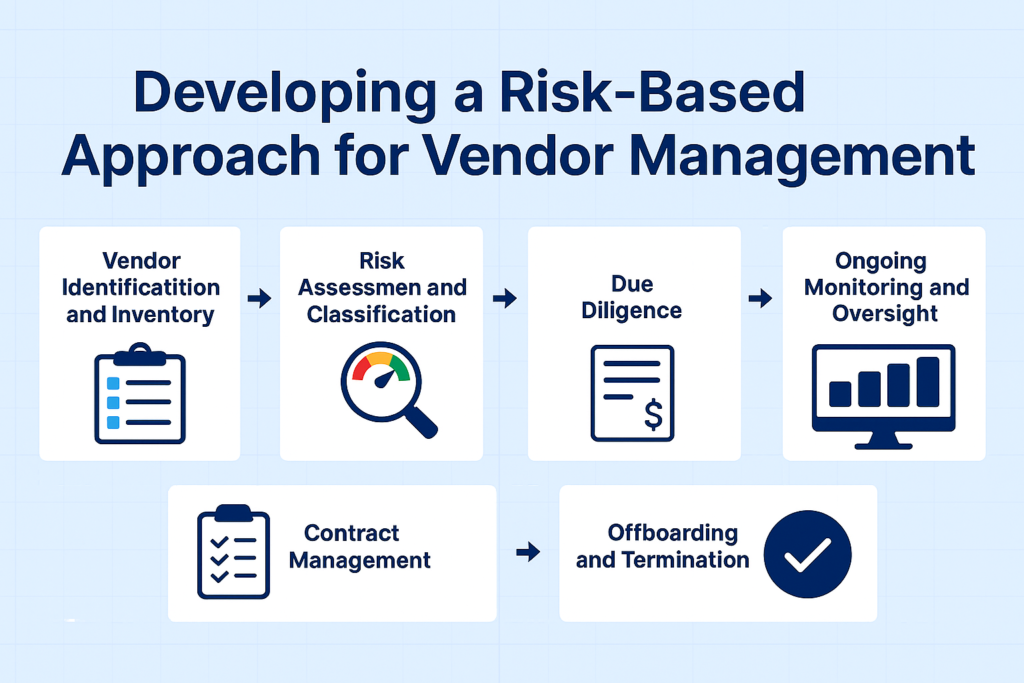
1. Vendor Identification and Inventory
The foundation of any vendor risk program is visibility. Maintaining a comprehensive inventory of all vendors, no matter how small, ensures that no relationship falls through the cracks. This list should capture key details such as services provided, contract values, data access, and business criticality.
2. Risk Assessment and Classification
Once vendors are identified, the next step is to evaluate and classify them by risk level. High-risk vendors often require deeper scrutiny and stronger controls. Examples include:
- Safety & Insurance: For service providers, review insurance coverage, OSHA records, and written safety programs.
- Quality Management: For critical suppliers, assess whether they maintain ISO certifications or other quality management systems.
- Cybersecurity: For vendors with access to sensitive data, evaluate internal security controls, incident response plans, and compliance with frameworks like NIST or ISO 27001.
This classification allows organizations to apply proportional oversight, more rigorous for high-risk vendors, and streamlined for low-risk ones.
3. Due Diligence
For high-risk and critical vendors, due diligence goes beyond surface-level checks. Organizations should collect and review:
- OSHA logs and safety performance data
- Certificates of insurance and EMR (Experience Modification Rate)
- Written quality and safety programs
- Cybersecurity and compliance questionnaires
- ISO or equivalent certifications
This process validates that vendors meet baseline requirements before contracts are signed or renewed.
4. Contract Management
Contracts are a powerful tool for risk mitigation. They should clearly define:
- Performance expectations and service-level agreements (SLAs)
- Insurance and compliance requirements
- Third-party oversight mechanisms
- Penalties or remediation steps for non-compliance
Embedding these elements upfront reduces ambiguity and strengthens accountability.
5. Ongoing Monitoring and Oversight
Vendor risk management doesn’t end at onboarding. Continuous monitoring ensures that vendors remain compliant and aligned with expectations. Key activities include:
- Tracking document expirations and revalidating certifications
- Reassessing safety and performance annually
- Reviewing updated written programs and policies
- Conducting periodic performance evaluations
This ongoing oversight helps organizations catch issues early and maintain strong vendor relationships.
6. Offboarding and Termination
When a vendor relationship ends, whether after a project or contract expiration, organizations must ensure a clean and secure exit. This includes:
- Final performance assessments
- Removal of vendor access to systems, sites, and data
- Retrieval of equipment or credentials
- Documentation of lessons learned for future engagements
A structured offboarding process reduces residual risks and protects organizational assets.
How Can BexUp Help
At BexUp, we empower organizations to implement a risk-based approach to vendor management with efficiency and fairness. Our platform provides the tools to:
- Assess vendors across multiple risk dimensions
- Automate due diligence and document collection
- Streamline monitoring and revalidation processes
- Ensure compliance without overburdening vendors
We believe vendor risk management should be effective, transparent, and accessible for both clients and their partners.
Ready to strengthen your vendor management program? Schedule a discovery call with us today to learn how BexUp can help you streamline your processes and achieve your goals at a fair price for all parties.
About the author:
Flavio holds an MBA in Corporate Finance & Project Management from the University of Dallas and has over a decade of experience in Vendor Risk Management. He helps organizations balance safety, quality, and efficiency in their contractor management programs. Connect with him on LinkedIn to continue the conversation.
About BexUp:
BexUp is an American company, based in Dallas, Texas, and part of the Bernhoeft Group, Latin America’s largest Vendor Risk Management provider. Since 1996, we’ve partnered with more than 250 leading organizations, including Amazon, Ford, Dow, BASF, and John Deere delivering a powerful contractor compliance platform backed by expert review services.
We help safeguard operations by ensuring vendors maintain exceptional safety performance, follow industry best practices, and meet insurance, tax, legal, and financial requirements through a streamlined, costeffective process that reduces risk and boosts efficiency.